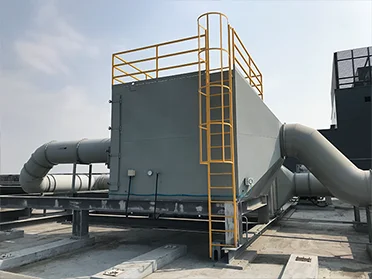
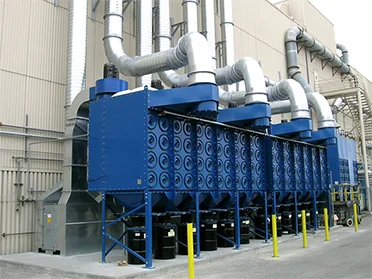

Cement Production

 Application
During industrial manufacturing and processing operations, large amounts of dust particles are easily generated and dispersed into the air, posing risks to employee health, reducing equipment efficiency, and even creating explosion hazards.
At PureFlow, we offer a wide range of high-quality industrial dust control solutions for industries such as cement, mining, construction, manufacturing, and food processing. Our solutions help enterprises effectively control dust emissions, ensure environmental compliance, and build a safe, efficient production environment.
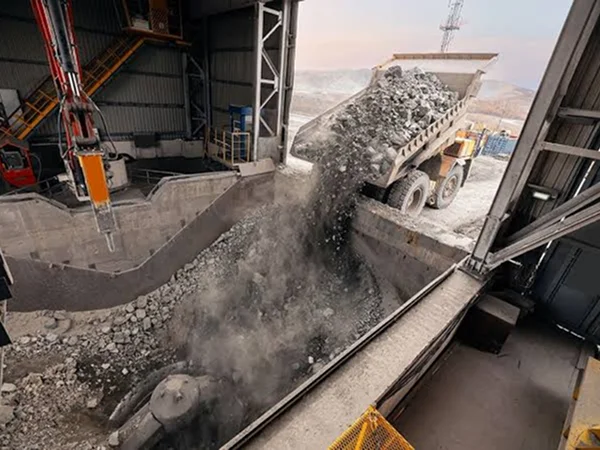
Industrial dust is commonly generated whenever solid materials are crushed, ground, conveyed, transferred, or disturbed.
Typical examples include raw material crushing and cement grinding in cement plants, ore crushing and screening in mining operations, coal handling and fly ash in power plants, grinding and polishing in metalworking, and the loading, conveying, and packaging of powders and bulk solids.
Dust characteristics can vary significantly in particle size, concentration, temperature, moisture content, abrasiveness, and chemical properties. Dust collection equipment should therefore be selected according to the actual operating conditions.

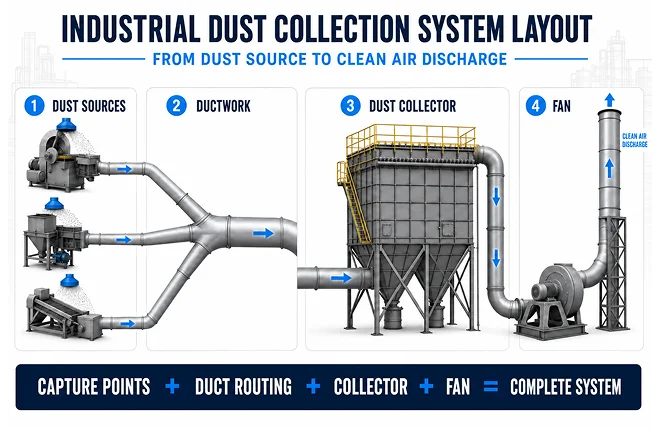
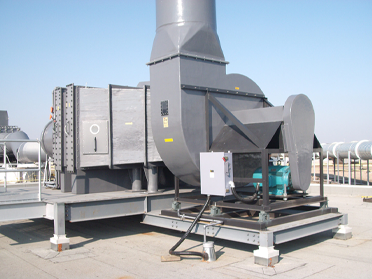
A typical industrial dust control system begins by capturing dust-laden air through hoods, enclosed transfer points, or local extraction systems. A fan then moves the contaminated air through ductwork to the dust collection equipment.
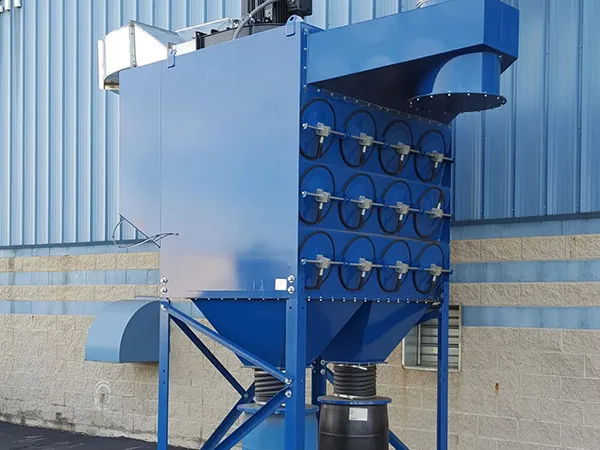
For most dry industrial dust applications, baghouses and cartridge dust collectors are widely used. Dust particles are captured on the surface of filter bags or cartridges while cleaned air passes through the filter media. Accumulated dust is periodically removed by pulse-jet cleaning, reverse air, or other cleaning methods and discharged into a hopper.
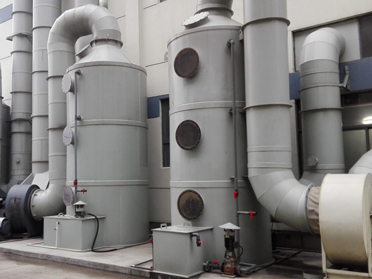
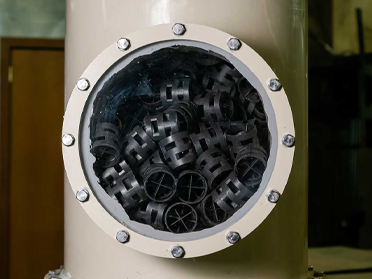
For some high-volume or high-temperature flue gas applications, Electrostatic Precipitators (ESPs) are also commonly used. In certain wet, sticky, or combined gas-and-particulate applications, a wet scrubber may be selected instead.